

On October 17, a crane operator working on the Brent Spence Bridge Corridor project in downtown Cincinnati died after the boom lift he was operating shifted and fell near Third Street and Pete Rose Way. He was taken to UC Medical Center with life-threatening injuries and died hours later. The Cincinnati Police Criminal Investigation Section and OSHA are both investigating, and the cause has not yet been determined.
We don't yet know what led to the equipment shifting, and speculating before investigators finish their work wouldn't serve anyone, least of all the crew who lost a colleague. But every time a crane-related fatality makes the news, it's worth asking a broader question: when OSHA closes out one of these investigations, what does it usually find?
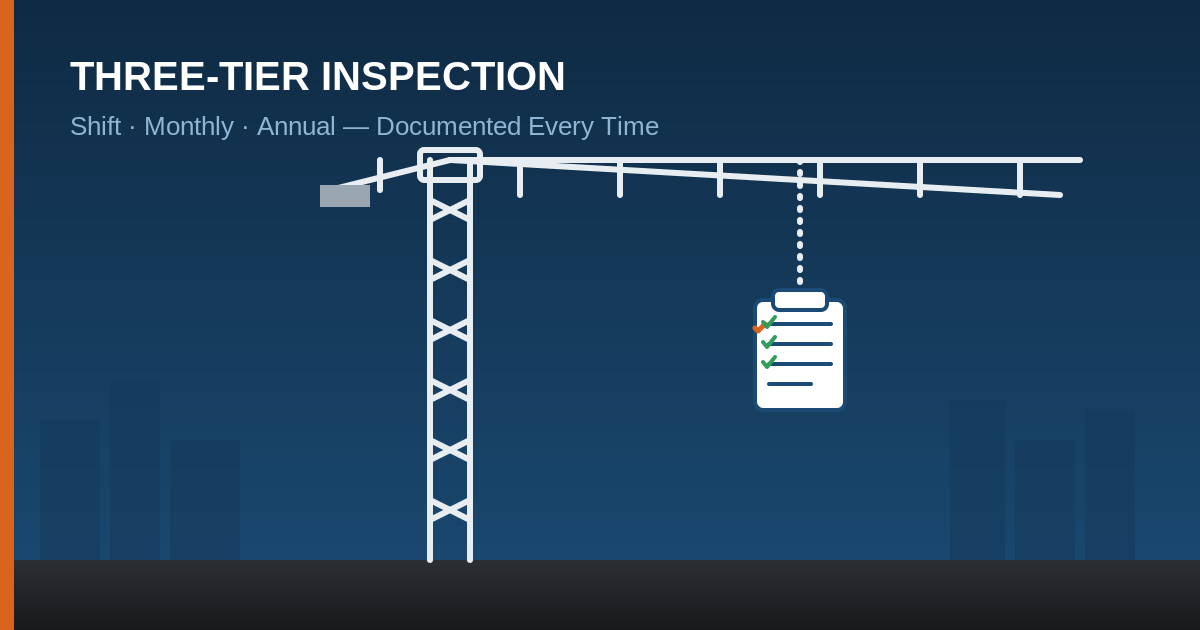
The answer, more often than not, isn't a dramatic structural failure. It's paperwork. Failure to maintain complete three-tier inspection records under 29 CFR 1926.1412 (shift, monthly, and annual) has landed in OSHA's top ten most-cited construction violations every year from 2019 through 2025. Inspectors aren't satisfied with a verbal "it looked fine this morning." They want the signed shift log, the monthly report, and the annual inspection by a qualified person, each one showing what was checked, what was found, and what was done about it.
That documentation isn't bureaucratic box-checking. It's the mechanism that forces someone to actually look, before the boom goes up and before the load goes out, and it puts a second set of eyes on equipment that a crew sees every day and can start to take for granted. It's also the record that shows, after something goes wrong, whether the system worked the way it was supposed to.
Three things worth verifying on your own site this week:
Shift inspections are being documented, not just performed. A competent person's signature and a completed checklist, every shift, every crane.
Monthly and annual inspection records are current and on file, not pending because "we'll catch up on paperwork later."
Operator evaluations reflect the equipment and conditions on your current job, not a generic certification filed away months ago.
A crew losing a coworker is a loss no inspection checklist can undo. But tightening our own documentation discipline today, not after an OSHA letter arrives, is something every operator and safety lead can control. That's the least we owe the people doing this work.




Lorem ipsum dolor sit amet, consectetur adipiscing elit. Suspendisse varius enim in eros elementum tristique. Duis cursus, mi quis viverra.
Lorem ipsum dolor sit amet, consectetur adipiscing elit. Suspendisse varius enim in eros elementum tristique. Duis cursus, mi quis viverra.