


Understand the core principles of safe rigging during lifting activities.
Steel erection introduces added risks beyond standard rigging. These conditions require tighter control, planning, and discipline in execution.
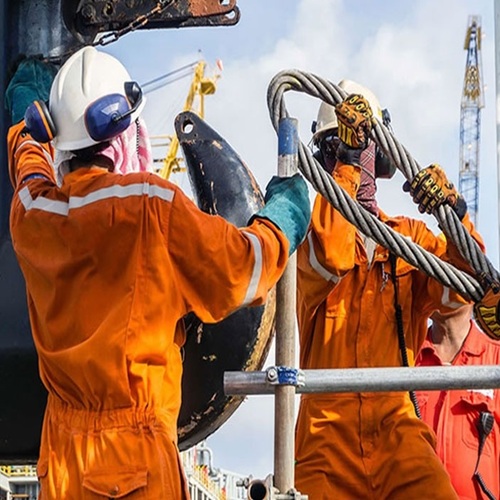
Key Safety Practices
Operator Control
Licensed operators are responsible for all crane operations under their control. They have full authority to stop work or refuse a lift if safety concerns arise.
Hoist Riding
Do not use the crane’s hook, headache ball, or load to transport personnel.
Safety Latches
Safety latches must remain functional. Only a qualified rigger can approve exceptions, and only if equal or greater protection is in place through a site-specific plan.
Working Under Loads
Plan lifts so no worker is ever required to be under a suspended load. If that condition exists, the plan is wrong—fix it before the lift.
Communication & Equipment Awareness
Hand Signals
Operators and signalers must be aligned on standard hand signals before any lift begins.
Rigging Equipment
Each sling type has specific limits, inspection requirements, and removal criteria. Know them—don’t guess.
Inspection Requirements
Pre-Shift Inspections
A competent person must inspect the crane and components before each shift
A qualified rigger must inspect all rigging gear
If it’s not inspected, it’s not safe to use.
Bottom Line
Rigging comes down to control, planning, and discipline:
The operator owns the lift
No shortcuts on safety systems
No one under the load
Inspect everything, every shift
Do it right the first time—there’s no margin for error in steel erection.




Lorem ipsum dolor sit amet, consectetur adipiscing elit. Suspendisse varius enim in eros elementum tristique. Duis cursus, mi quis viverra.
Lorem ipsum dolor sit amet, consectetur adipiscing elit. Suspendisse varius enim in eros elementum tristique. Duis cursus, mi quis viverra.