

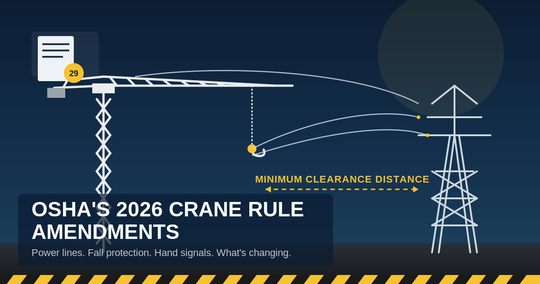
OSHA has put the Cranes and Derricks in Construction standard back on its rulemaking agenda. Filed under RIN 1218-AC81, the proposed rule, officially titled "Amendments to the Cranes and Derricks in Construction Standard," is slated to publish as a Notice of Proposed Rulemaking this month, correcting and clarifying the regulation that has governed crane operations under 29 CFR 1926 Subpart CC since 2010. OSHA has labeled the package "deregulatory" under the current executive order on regulatory review, but don't mistake that for a non-event: several of the fixes touch provisions crews rely on every single lift.
The headline change is semantic, but it carries operational weight. OSHA intends to replace "minimum approach distance" with "minimum clearance distance" everywhere it appears in the standard, specifically to remove the ambiguity that has dogged power line work for over a decade. The agency is also clarifying how demarcated boundaries should be used near energized lines, a provision at the center of more enforcement disputes than almost any other section of the crane rule. If you've ever argued with an inspector, or argued internally, about where the line actually is, this is the fix aimed at you.
The rest of the package reads like a punch list of errors OSHA has been meaning to clean up since the rule's original 2010 publication. It corrects power line voltage references for both AC and DC systems, narrows the forklift provisions so they apply only to units fitted with a winch and boom rather than a bare winch or hook, clarifies an exclusion for articulating cranes, and adds four definitions that were left out of the final rule entirely. It also fixes a real error with teeth: current language lets body belts count as a personal fall arrest system, when the standard actually requires a personal fall restraint system. Expect that correction alone to get attention from fall protection auditors.
A handful of smaller items round out the proposal: swapping an erroneous "must" for "may" in several provisions, correcting a caption error in the standard hand signal diagrams, and resolving confusion around what counts as NRTL-approved equipment, including proximity alarms and insulating devices used for power line work.
None of this is final. The rule is at the Notice of Proposed Rulemaking stage, there's no legal deadline attached, and a public comment period will follow before anything changes in the Code of Federal Regulations. Historically, crane rule amendments at this stage take months to years to reach a final rule. That said, smart safety programs don't wait for the Federal Register to catch up with best practice. Three things worth doing now, while the proposal works through the process: first, audit how your rigging plans, job hazard analyses, and power line permits currently use the phrase "minimum approach distance," so your documentation and training are ready to shift to "minimum clearance distance" without creating confusion on the ground. Second, pull your fall protection equipment list and confirm riggers and operators working at height are issued a true personal fall restraint system, not a body belt mislabeled as arrest-rated gear. Third, check the NRTL listing status on your proximity alarms and insulating link devices; if that documentation is thin, close the gap now rather than after a final rule makes it a citable item.
The bigger point is one CSA members hear from us often: power line clearance and fall protection are two of the costliest places to get casual. A rule rewrite won't change the physics of a boom swinging into an energized line or a worker relying on the wrong harness hardware. Treat this proposal as a reminder to tighten documentation and training now, so that whenever OSHA finalizes the language, your site is already operating to the standard it's trying to describe.




Lorem ipsum dolor sit amet, consectetur adipiscing elit. Suspendisse varius enim in eros elementum tristique. Duis cursus, mi quis viverra.
Lorem ipsum dolor sit amet, consectetur adipiscing elit. Suspendisse varius enim in eros elementum tristique. Duis cursus, mi quis viverra.