

With frost advisories already hitting job sites across much of the country this week, most crews are thinking about cold weather as a comfort problem: extra layers, warmer gloves, shorter breaks. It is actually a capacity problem, and it starts well before anyone feels cold.
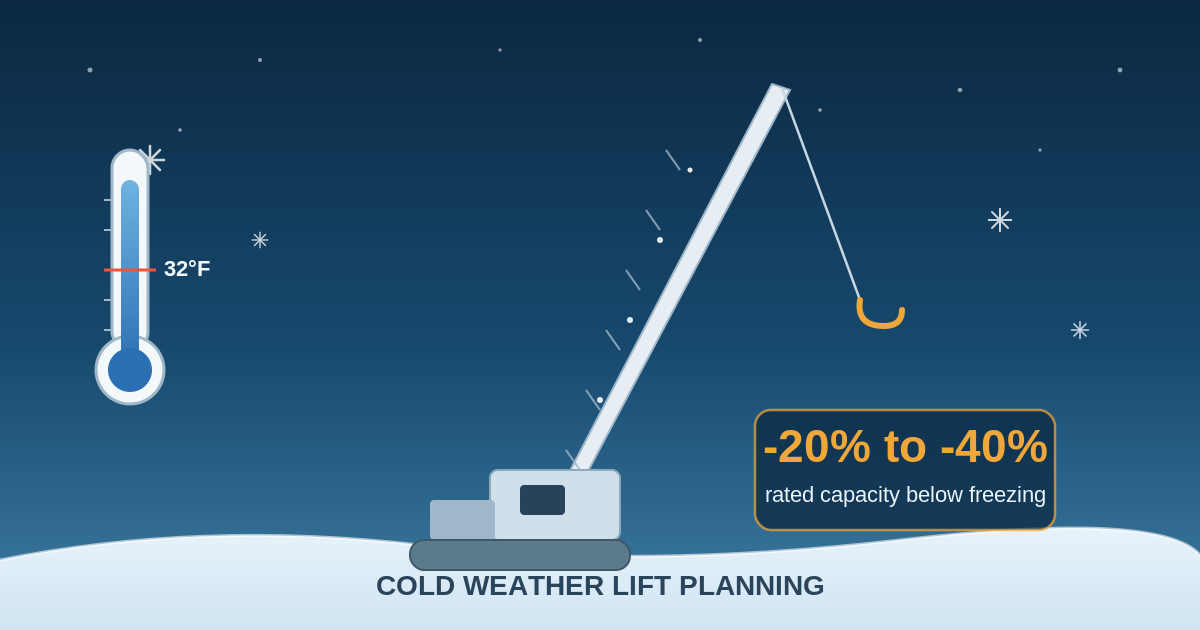
Steel behaves differently as temperatures drop. Below a certain point, structural steel shifts from ductile to brittle, meaning it absorbs less energy before cracking under load. The crane industry's common rule of thumb is to reduce capacity by roughly 1 percent for every degree below zero Fahrenheit, and many manufacturers recommend cutting rated loads by 20 to 40 percent once temperatures fall below freezing. A load chart that was accurate in October can be dangerously optimistic in a hard freeze.
It is not just the boom. Hydraulic fluid thickens in the cold, which shows up as sluggish or jerky function response right when smooth, predictable movement matters most. Wire rope becomes more prone to breakage as it stiffens, and any ice built up on the boom, hook block, or load adds weight that was never part of the lift plan. None of this shows up on a visual walk-around unless someone is specifically looking for it.
Operators take a hit too. Cold hands lose grip strength and fine motor control, bulky cold-weather gear can interfere with harness fit and fall protection, and the combination of cold, wind, and fatigue erodes judgment faster than most people expect. A rigger who is miserable is a rigger who rushes.
Three things worth checking before a winter lift: confirm the load chart and rated capacity have been adjusted for actual ambient temperature, not the forecast high; verify hydraulic fluid is rated for cold operation and the system has been properly warmed up and cycled before any lift; and inspect the boom, rigging, and load path for ice accumulation, then reassess wind and visibility, since both tend to be worse in winter conditions.
None of this replaces the daily pre-use inspection already required under OSHA's crane standard, but cold weather is exactly the kind of condition that daily inspection needs to account for rather than rubber-stamp. If the capacity, the equipment, or the operator is not ready for the conditions on site, the lift can wait. That call is always easier to make before the boom is loaded than after something has already gone wrong.




Lorem ipsum dolor sit amet, consectetur adipiscing elit. Suspendisse varius enim in eros elementum tristique. Duis cursus, mi quis viverra.
Lorem ipsum dolor sit amet, consectetur adipiscing elit. Suspendisse varius enim in eros elementum tristique. Duis cursus, mi quis viverra.