

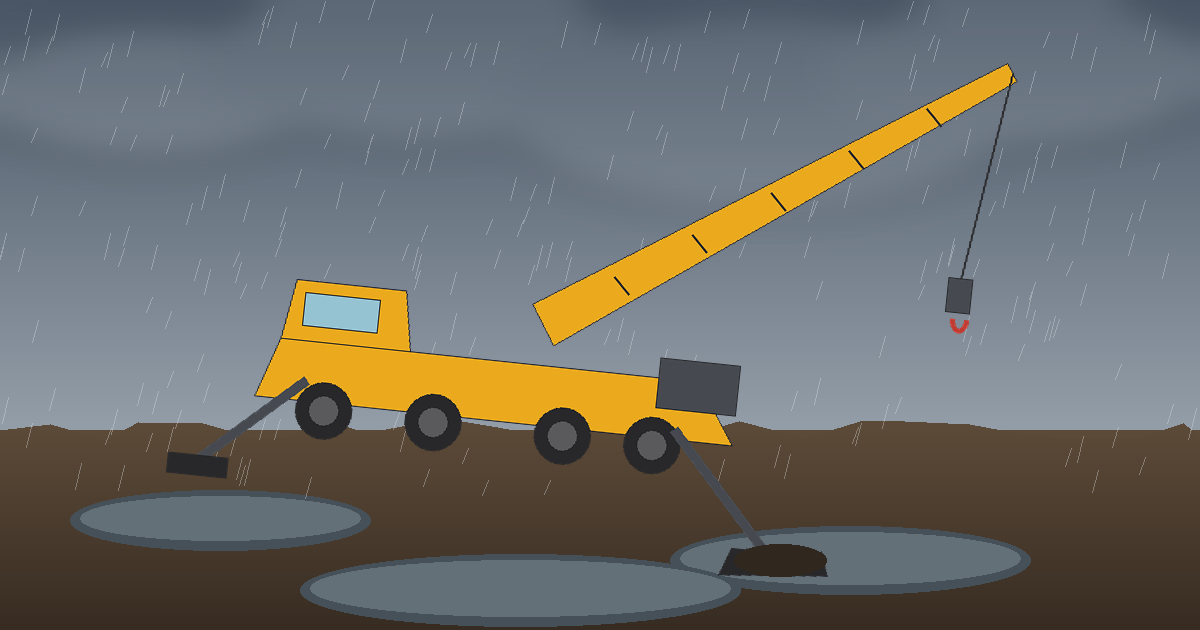
In April, an outrigger failure sent a mobile crane overturning onto a home in Phenix City, Alabama, sending one person to the hospital. In October, half a world away, a crane toppled onto the roof of an elderly care home in Permatang Tinggi, Penang, injuring an 84-year-old resident. Different countries, different crews, different cranes, but investigators pointed to the same underlying failure in both: the ground beneath the outriggers wasn't capable of bearing the load it was asked to carry.
It's tempting to file these under operator error, but ground condition failures rarely start with the person at the controls. They start earlier, in the setup, when someone assumes the pad that worked last time will work this time, or skips a careful look at soil that looks solid on the surface but isn't underneath. OSHA's crane standard, 29 CFR 1926.1402, is direct about this: cranes must be set up on ground that is firm, drained, and graded sufficiently to support the equipment, with blocking, cribbing, or mats added wherever the ground alone can't carry the load. That isn't a one-time site assessment. It's supposed to happen before every setup.
Fall is when this requirement gets tested the hardest. Rain saturates soil that held a crane fine all summer, and saturated ground can lose half its dry bearing capacity or more. A site graded and compacted in July can be a different animal in October after a week of rain, even though nothing about the crane or the load has changed. The failure point isn't the crane. It's the assumption that yesterday's ground conditions still apply today.
Three things are worth confirming before every outrigger goes down, not just on the first day of a job. First, current bearing capacity, not a carryover assumption: a competent person needs to evaluate the ground for that specific setup, that day, rather than relying on what the soil did last week or on a different corner of the site. Second, pad and mat sizing matched to the actual outrigger load, calculated by dividing the maximum outrigger reaction force by the allowable ground bearing pressure, rather than defaulting to whatever pad is already on the truck. Third, cribbing that actually meets the standard: rated hardwood or built-up plywood, stacked at least three layers deep, with each layer laid at a right angle to the one below it.
None of this is new information to anyone who has been through crane certification training, but it's exactly the kind of step that gets compressed when a schedule is tight or a crew has set up on the same pad a dozen times without incident. Two tip-overs four months apart, on two continents, show what happens when that compression goes one step too far.
The fix isn't complicated: make the ground assessment a documented, non-negotiable part of every setup, and give the competent person the authority, and the time, to say no when conditions don't check out. Cranes don't fail because of bad luck. They fail when someone assumes the ground will hold instead of confirming it will.




Lorem ipsum dolor sit amet, consectetur adipiscing elit. Suspendisse varius enim in eros elementum tristique. Duis cursus, mi quis viverra.
Lorem ipsum dolor sit amet, consectetur adipiscing elit. Suspendisse varius enim in eros elementum tristique. Duis cursus, mi quis viverra.