


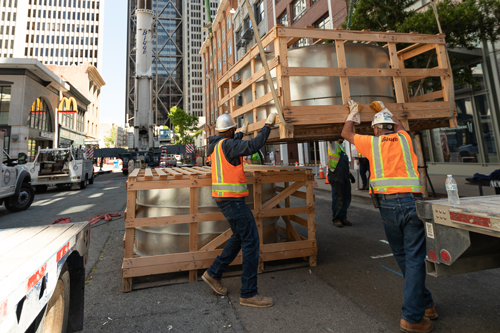
Experience may be a good teacher, but when it comes to cranes, it is often the most brutal one.
Over the years, too many workers have learned hard lessons only after witnessing, or being involved in, catastrophic incidents. Like the laborer who stepped between a crawler crane and a building column, unaware that the crane was about to swing. The counterweight pinned and crushed him before anyone could react. Or the crew member leaning on a crane, chatting casually during a lift. When the load contacted a live power line, electricity surged through the machine and through him.
These tragedies do not happen because people are careless. They happen because they forget that danger is always present when working near a crane, even when everything seems routine.
Keep Out from Under and Around the Load
Every lift carries risk. Even when rigging is textbook perfect and the operator is highly skilled, equipment failure or unexpected movement can occur in seconds. Standing under a suspended load, or within its swing radius, is never worth the risk.
You may hear, “It’s just for a second,” but that second is all it takes for a life to change. Steel does not give second chances. That is why a basic rule should always be followed:
- If the load is in the air, you do not belong underneath it or anywhere near where it could swing.
Being Seen Means Staying Safe
Crane operators are focused on executing complex maneuvers. Their visibility is limited by the machine, the load, and the environment. If you are near the crane but outside their line of sight, you are not just out of mind, you are in harm’s way.
Before entering any part of a crane’s working area, make sure you have made yourself known. Use hand signals, radios, or communicate through a signal person. Assume the operator cannot see you unless you have confirmed otherwise.
Do Not Treat the Crane as a Resting Spot
Some workers get in the habit of leaning on the crane between tasks. It feels stable, like part of the jobsite furniture. But if that crane touches a power line, it becomes energized in an instant. Anyone leaning against it becomes part of the circuit.
Electricity is not visible. You will not get a warning. Stay off the crane at all times.
The Final Lift
The danger around cranes often hides in plain sight: bad habits, assumptions, and small risks taken with the belief that "this time" will be fine. Respecting the space around a crane is not just about avoiding obvious hazards. It is about recognizing how quickly things can go wrong.
What is one change you made, big or small, that helped you work safer around cranes?




Lorem ipsum dolor sit amet, consectetur adipiscing elit. Suspendisse varius enim in eros elementum tristique. Duis cursus, mi quis viverra.
Lorem ipsum dolor sit amet, consectetur adipiscing elit. Suspendisse varius enim in eros elementum tristique. Duis cursus, mi quis viverra.