

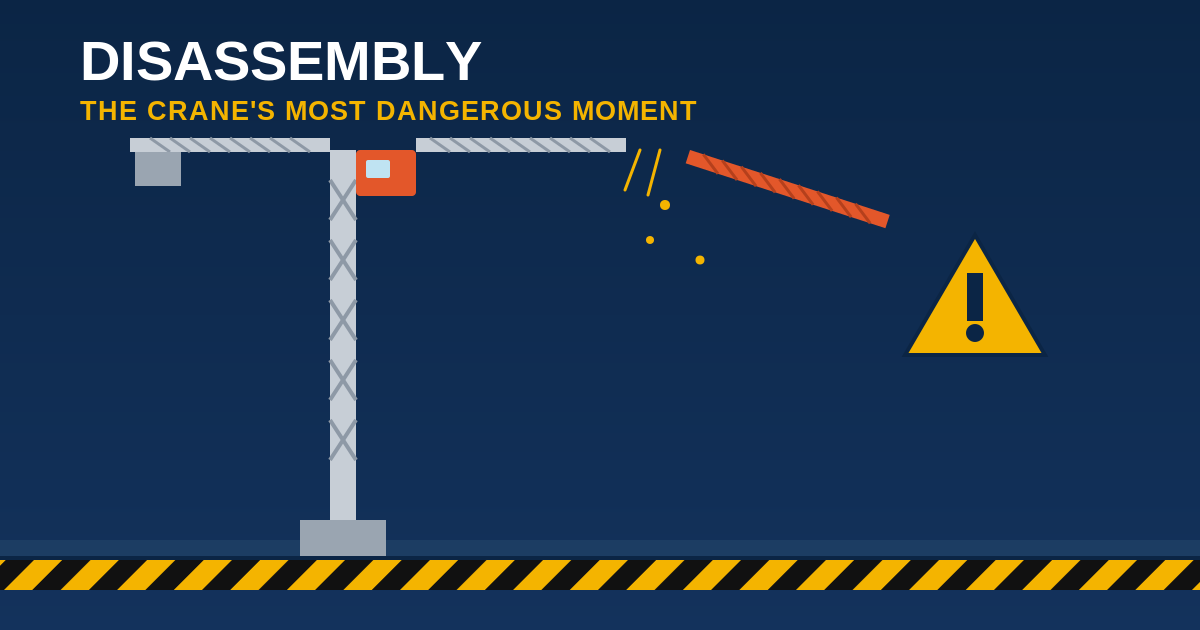
On Tuesday afternoon, November 11, a crane at the Stadium Flats apartment construction site in downtown South Bend, Indiana suffered what the local fire department called "a catastrophic failure leading to the collapse." It fell across Monroe and Lafayette streets just after 3:15 p.m., narrowly missing a passing car and striking the top of an unoccupied building under construction. No one was hurt. A second crane had to be brought in just to remove the wreckage.
What makes this incident worth a closer look isn't the outcome, thankfully a near-miss, it's the timing. The crane didn't fail while hoisting steel or setting a panel. It failed while crews were taking it apart. That single detail should change how every operator, rigger, and site supervisor thinks about the job that comes after the last pick.
Assembly and disassembly are widely regarded, including by OSHA, as the most hazardous phases of crane work, in many respects more dangerous than routine lifting. As sections, counterweights, and pins come off, components that were stable a moment earlier become unsupported and can shift, rotate, or fall the instant a retaining device is removed. Add in the fatigue and schedule pressure that tend to show up at the tail end of a job, when everyone wants the crane gone and the site cleared, and the margin for error narrows fast.
That's exactly why OSHA's crane standard, 29 CFR 1926 Subpart CC, requires a qualified Assembly/Disassembly, or A/D, Director to oversee every teardown. The director's job isn't paperwork. It's making sure the crew understands the specific sequence for that machine, knows which positions to avoid, and confirms that rigging and lifting lugs are rated for the operation actually being performed, not just assumed from the original erection.
Three things worth verifying before any crane comes down on your site: first, that a named A/D director has briefed the crew on the actual teardown sequence and hazard zones, not a generic toolbox talk; second, that every boom section or component stays positively supported, by crane, taglines, or cribbing, before any pin or bolt is pulled, and that no one stands beneath or within the fall radius while that happens; third, that the rigging and lifting hardware used for disassembly has been inspected and rated for that specific load, not carried over by assumption from assembly day.
As of this writing, it isn't yet clear whether Indiana OSHA will formally investigate the South Bend collapse, and the developer says it's cooperating with its own engineers and the fire department to determine the cause. Nobody was hurt this time, and that's worth being grateful for, but a boom coming down a few feet differently could have ended very differently.
Teardown day shouldn't be treated as the easy part of the job. Walk your A/D plan the same way you'd walk a critical lift plan, and make sure the crew taking the crane down is paying as much attention as the crew that put it up.




Lorem ipsum dolor sit amet, consectetur adipiscing elit. Suspendisse varius enim in eros elementum tristique. Duis cursus, mi quis viverra.
Lorem ipsum dolor sit amet, consectetur adipiscing elit. Suspendisse varius enim in eros elementum tristique. Duis cursus, mi quis viverra.